

Last Updated on June 7, 2026 by David
When your slate floors appear lacklustre or uneven after cleaning, it may not merely reflect dirt accumulation. Numerous households face challenges arising from residue, worn protective coatings, uneven drying, or surface alterations that only become noticeable after cleaning. A successful slate cleaning strategy commences with recognising the difference between removable dirt and embedded residue. It also involves understanding the behaviour of textured finishes, managing residual moisture from mopping, and acknowledging how foot traffic influences the surface’s colour.
How to Determine the Causes of Dull or Uneven Slate Floors After Cleaning
If your slate floor appears dull, patchy, or uneven following cleaning, the initial step is to identify the underlying cause. Even a floor cleaned with warm water and a well-wrung mop can dry with a lacklustre finish due to residues, dirty rinse water, or moisture pooling in lower areas.
Slate can be misleading; it may seem clean while reflecting light inconsistently. You might observe grey patches, pale tracks, cloudy watermarks, or darker edges, each signifying different underlying issues.
Common surface dirt typically responds well to vacuuming, washing, rinsing, and proper drying. Loose grit, dust, pet hair, and kitchen debris are often easily removed with a mop or soft brush, resulting in a fresher appearance once the dirty water has been eliminated.
If your slate floor quickly loses its shine again, this often indicates uneven finishes rather than merely dirt. Buildup along edges, recessed areas, and excessive topical materials can obscure the tile, causing clean sections to appear lacklustre due to the old coating interfering with the drying process.
Pale tracks in the centre of the room signify that high-traffic areas behave differently from quieter edges. Busy paths accumulate grit from shoes, leaving light trails that dull the surface and create a chalky appearance, even post-cleaning.
If the edges of your slate are darker or patchy, it suggests that the outer sections retain more residue than the central areas. Coating buildup tends to accumulate around the edges and in recessed spots, resulting in a dirty appearance even when normal cleaning has effectively removed loose dirt.
Visible streaks after mopping indicate that although the water has lifted dirt, it has not entirely removed it. Cloudy water, detergent traces, soap residue, and dirty mop water can settle back into the textured finish, dulling the floor as it dries.
If your slate feels sticky, this indicates that the cleaning or rinsing process has left behind residue. It is vital to use a pH-balanced cleaner specifically formulated for routine maintenance. A residue-free cleaner with mild surfactants should effectively cleanse without leaving a film that attracts further dirt.
If your slate exhibits clean high points alongside darker low points, the surface is drying unevenly. Naturally split slate features ridges and troughs that can trap moisture, fine grit, and wash water in the lower textures while the elevated areas dry first.
The riven texture of slate presents unique cleaning challenges, as its mechanically split nature adds character while providing more areas for residue to accumulate, complicating sealing compared to smoother tiles.
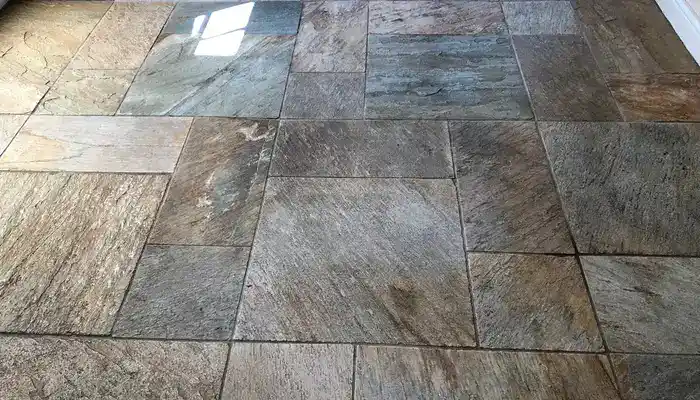
Even clean slate can appear flawed when the goal is an even, rich colour. New installations often lack adequate protection or are treated with unsuitable surface finishes, preventing the floor from showcasing its full depth until outdated residues and poor coatings are properly addressed.
A loss of colour does not merely signify dirt. It indicates that the surface has worn down due to foot traffic, taking the pigment along with it — not just dirt that requires cleaning. Repeated scrubbing may only highlight the paler areas; the first step towards correction is removing contamination, halting further abrasion, and applying suitable protection where the surface can accommodate it.
Fading occurs due to pigment loss, traffic abrasion, and surface wear, leading to a decline in visual richness. Homeowners may observe washed-out patches, a dull finish, and reduced colour in high-traffic areas. Addressing this issue necessitates first removing contamination and then restoring appropriate protection where the surface can accept it.
Powdery surface residue consists of loose or degraded material remaining after wear, coating breakdown, or ineffective cleaning. Homeowners may notice a dull finish, powder formation, residue buildup, and challenges in cleaning. Professional intervention is necessary to remove surface contamination and reinstate a stable finish before regular maintenance can resume.
Sealer failure occurs when the protective layer can no longer manage absorption, drying, or soil release. Homeowners may notice water soaking in, a patchy appearance, rapid re-soiling, or inconsistent colour. Professional intervention involves removing the failed surface film and applying appropriate protection only once the tile is clean and dry.
Micro-scratching refers to fine surface damage caused by grit, abrasive pads, or harsh scrubbing. Homeowners may notice a grey, flat, or hazy surface when light strikes it. Correcting this issue involves stopping the abrasion and restoring the correct protective finish, steering clear of stronger cleaners.
Routine cleaning should protect slate by removing loose grit before wet mopping, managing moisture, and preventing detergent residue. Effective ongoing maintenance — employing pH-neutral cleaners, removing grit prior to mopping, and resealing at appropriate intervals — is crucial for prolonging the floor’s lifespan.
Be cautious with steam cleaning, as it may not be a quick fix. The risk of heat damage, sealer breakdown, moisture penetration, surface peeling, coating degradation, and loss of protective layers can jeopardise the floor’s integrity, particularly if a surface film already shows signs of wear.
Different areas of the home impose varying demands on slate, including kitchens, hallways, boot rooms, and entrances of period properties. Hard water can leave unsightly spots and chalky marks, while garden grit in rural homes may accelerate surface wear before homeowners notice a significant issue.
A clean slate floor should not be judged merely on whether the mop water appears dirty. A more reliable indicator is whether the surface dries evenly, feels free from sticky film, maintains consistent colour, and remains cleaner for a longer duration after soil has been removed.
How Different Slate Sources Influence Cleaning Outcomes
If one slate floor dries evenly while another remains patchy despite following the same cleaning regimen, the tiles may not behave uniformly due to their sources. Variations in slate types can significantly affect cleaning effectiveness since slate is not a uniform material. Welsh slate typically possesses high density and hardness with low porosity, whereas Indian slate is often softer and more porous, making it more vulnerable to absorption issues.
The surface texture also plays a crucial role in determining cleaning results, as natural cleavage and mechanically split faces retain soil differently. A smoother surface may release dirty water quickly, while a more uneven texture can trap moisture and residue in low spots, even with identical cleaning products and methods applied.
Slate sourced from China can exhibit inconsistent quality, underscoring the importance of testing and proper sealer matching rather than assuming that a single cleaning product will work for all floors. This variability explains why two slate floors can undergo the same maintenance routine yet dry with differing colour, depth, and definition.
What Underlying Issues Contribute to Marks and Dull Patches Beneath the Slate Surface?
Marks beneath the visible surface necessitate careful examination before resorting to harsher cleaning methods. A patch may signify trapped residues, coating buildup, fading colour, or early layer separation rather than just dirt resting on the tile.
Sealer buildup can entrap fine soil within topical excess, edge buildup, recessed areas, and application residues. Homeowners might notice uneven finishes or a floor that appears dirty after cleaning; addressing this involves removing the interfering layer before assessing the tile’s true condition.
Not every dull patch indicates dirt waiting to be scrubbed away.
Delamination occurs when layers separate due to foliation failure along vulnerable mineral planes. Homeowners may observe flaking, lamination loss, or weakened surfaces. Correcting this situation requires stabilising the affected area rather than forcing additional water, cleaner, or abrasion into it.
How Surface Finishes Influence Safe Cleaning Methods for Slate Floors
Using inappropriate tools on specific slate finishes can exacerbate the floor’s appearance, even with the best cleaning intentions. A fine-honed slate floor presents a smooth, consistent surface that diffuses light evenly, while an impregnating sealer maintains the natural riven texture, and a topical sealer adds a low surface sheen.
<a href=”https://fabritec.org/sandstone-cleaning-simplified-for-effortless-care/”>If the finish is smoother</a>, managing water, cleaner dilution, and residue removal becomes simpler since the mop head contacts the surface uniformly. This does not make the floor immune to detergent residue, but it reduces the likelihood of dirty rinse water settling in recessed areas.
If the finish is more uneven, the riven texture presents a greater cleaning challenge, as moisture and soil can become trapped within the textured surface. Tailoring cleaning methods to the finish will significantly enhance the floor’s appearance. A professionally restored and correctly sealed floor is much easier to clean and maintain compared to one that is worn or improperly treated.
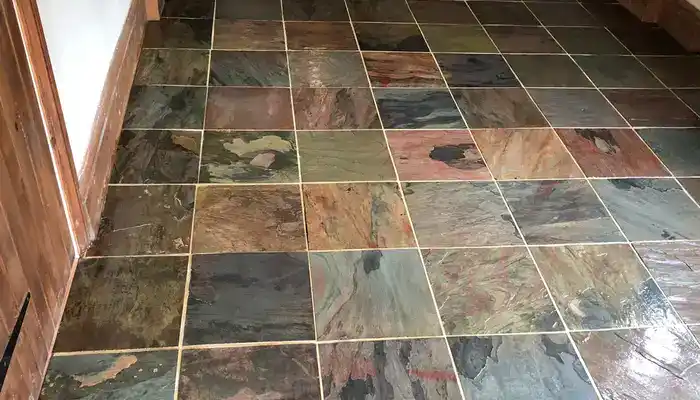
Why Uneven Slate Accumulates More Dirt Than Smooth Floors
If the high points of your slate appear cleaner than the lower textured areas, it indicates that the floor is trapping soil within its uneven surface. Uneven slate offers dust, fine grit, and dirty mop water more opportunities to settle compared to a smoother surface. The raised areas may initially look clean, while the lower textures still retain cloudy water, soap residue, and ingrained dirt.
The riven texture functions like shallow relief rather than a flat plane. During professional cleaning, a carbon brush, polypropylene brush, or stiff nylon detail brush can penetrate deep grooves, while a flat mop often skims over elevated points, leaving behind soiled residue.
Slurry extraction is vital to prevent loosened contaminants from re-drying into the riven surface. A wet vacuum effectively manages contamination by promptly removing dirty solutions, ensuring that residues are eradicated before the floor dries and regains its dull appearance.
Why Regular Mopping Can Lead to a Dull Slate Finish
Frequent mopping may cause slate to appear dull if the water lifts soil but does not entirely remove it from the surface. Employing a well-wrung mop, a wringer bucket, warm water, and clean rinse water minimises over-wetting and prevents cloudy water from being spread across porous slate.
Neutralising alkalinity after deep cleaning is crucial, as an alkaline cleaner can leave residues if dilution, dwell time, and thorough rinsing are not carefully controlled. A mildly acidic solution or neutralising cleaning agent may be used professionally to rinse away alkaline residues, preserving the effectiveness of the sealer and preparing the floor for safe drying.
For routine cleaning, selecting a pH-neutral stone cleaner is advisable, as it supports pH balance, routine maintenance, and a residue-free surface. For more practical cleaning and sealing advice, refer to this slate cleaning and sealing guide, which emphasises that removal is key rather than mere wetting.
How Sealer Buildup Can Make a Clean Slate Floor Appear Dirty
If your slate seems dirty after washing, the issue may not be loose soil at the surface but rather the presence of old protective layers lingering on the tile. Sealer buildup can entrap fine soil and detract from the slate’s appearance, making it appear dirty even after cleaning. Coating accumulation, edge buildup, topical excess, recessed areas, and application residues can interfere with drying and create uneven finishes.
Old surface films can obscure clean tiles beneath while presenting a grey or patchy appearance on the surface. Professional treatments for buildup involve solvent action, acrylic removal, wax dissolution, chemical penetration, coating stripping, and sealer removal — these are not routine home cleaning tasks.
Colour-enhancing protection impacts appearance only after the surface has been cleaned, residue-free, and dried. Concepts such as mineral activation, colour enhancement, pigment deepening, visual richness, and breathable barriers are discussed in this wet-look slate explanation, linking appearance to appropriate protection rather than just dirt removal.
How Common Cleaning Mistakes Gradually Alter Slate Colour and Surface Definition
Cleaning errors tend to accumulate over time, causing changes to the floor before homeowners notice a problem. Over-wetting, steam cleaning, harsh cleaners, residue buildup, and repeated abrasion can all affect colour, texture, and definition without leading to immediate failure.
How Steam and Heat Affect Slate
Steam-induced sealer failure occurs when heat softens or disrupts a protective layer, forcing moisture into the surface. Homeowners may observe surface peeling, risks of flaking, coating degradation, and instability of the surface; correction begins with discontinuing steam use and evaluating the compromised layer.
The Effects of Harsh Cleaners and Residue
Using aggressive cleaners can lead to colour changes, sealant stripping, and permanent damage. Products intended for cement residue or limescale should never be regarded as general slate cleaners, as mineral deposit treatment requires careful testing, neutralisation control, and rinsing discipline.
Impacts of Abrasion and Dirty Water
Loose grit and repeated scrubbing can gradually diminish surface definition. A nylon detail brush can effectively remove loose salt or white film in a controlled manner, but abrasive pads and dirty water left in grout joints can result in dulling, detergent traces, and recurrent rinsing challenges.
Best Practices for Sustaining Your Slate’s Lasting Cleanliness
If your slate looks good for a brief period after cleaning but quickly loses its shine again, it’s time to enhance your maintenance routine. Effective moisture control, proper cleaner dilution, thorough residue removal, grit management, and drying practices play significant roles in determining whether the floor remains clear between cleans.
- Vacuum with a soft brush before wet mopping to prevent loose grit from damaging high-traffic areas.
- Utilise a well-wrung mop head, warm water, and a clean bucket to avoid over-wetting the floor.
- Change rinse water before it becomes cloudy, as dirty water can redeposit soil into the texture and grout.
- Employ a finish-safe cleaner at the correct dilution rate, then dry thoroughly with a soft cloth where water spots form.
Proper maintenance mitigates premature dullness by managing moisture and preventing residue from escalating into a maintenance issue. Avoid steam cleaning, as heat damage and moisture penetration can compromise the protective layer, while careful daily cleaning helps the floor stay cleaner for longer.
When to Seek Professional Help for Your Slate Floor
If standard cleaning fails to improve the floor’s appearance, the issue may have escalated beyond routine home maintenance. Failed coatings, embedded residues, surface breakdown, and damage require evaluation since mopping alone can simply redistribute the same contamination.
- Water soaks in quickly, darkens the tile, or fails to bead in high-traffic areas.
- Old coatings present a patchy, yellowed, sticky, or darker appearance around the edges.
- White chalky dust, mineral salts, haze, or surface deposits reappear after rinsing and drying.
- Flaking surfaces, peeling layers, lamination loss, or weakened areas become apparent following moisture stress.
Professional restoration is vital when cleaning cannot separate soil from failed finishes or structural changes. The floor will show significant improvement following intervention, provided the surface can be stabilised, cleaned, and protected without causing further damage.
What Actions to Take When Cleaning, Sealing, or Damage Demands Specific Guidance
If your slate remains dull, patchy, faded, or unstable after safe cleaning, the next steps depend on the visible issues at hand. The appropriate course of action relies on whether the problem pertains to cleaning failure, old coatings, steam damage, colour loss, or surface deterioration. A floor with detergent residue buildup requires different treatment than one with layer separation, moisture entrapment, grout haze, or protective sealant failure.
Cleaning failure typically indicates a need for residue removal, controlled moisture, and safer routine upkeep. Old coatings and sealer buildup necessitate assessment of the coatings, while colour loss and fading should be understood as pigment loss, visual degradation, and surface wear rather than mere dirt.
For a thorough understanding of slate behaviour, damage boundaries, and related guidance, refer to this comprehensive overview of slate floors in UK homes. This resource helps keep this page focused on cleaning results while addressing deeper topics like sealing, deterioration, and long-term care.

David Allen — Abbey Floor Care
David Allen brings over 30 years of experience working with slate floors across the UK at Abbey Floor Care. His practical knowledge of material behaviour, restoration sequencing, and long-term floor maintenance informs every article published under the Abbey Floor Care name.
This article How To Clean Slate Floors? When They Stay Dull was first found on https://www.abbeyfloorcare.co.uk
The Article Cleaning Slate Floors: Revive Dull Surfaces Easily appeared first on https://fabritec.org
The Article Revive Dull Slate Floors with Easy Cleaning Tips Was Found On https://limitsofstrategy.com
The Article Easy Cleaning Tips to Revive Dull Slate Floors found first on https://electroquench.com